Paperwork to Sell a Junk Car: The 6-Document Checklist
Selling a junk car should take an afternoon, not a week. What usually stretches it out isn't the tow truck or the condition of the car. It is a folder that is missing one piece of paper. A buyer hands you a cash offer, you go looking for the title, and the sale stalls while you figure out where it went.
The good news is that the document list is short and predictable. A junk car sale rests on one idea: you have to prove you own the car and have the right to sign it away. Every document below either proves that, protects you after the car leaves, or closes out a loose end like a paid-off loan. Handle them up front, and the buyer can pay you and haul the vehicle the same day.
Requirements vary by state, so treat this as a general checklist and confirm the specifics with your state's DMV or MVD before you sign anything. What follows is the paperwork most buyers ask for and why each piece matters.
QUICK ANSWER: Most junk car sales need six things: the vehicle title in your name, a photo ID that matches the title, current or recent registration, a simple bill of sale, a lien release if the car ever had a loan, and a release of liability or notice of transfer filed with the state. Rules vary by state, so check your DMV or MVD.
The Title Is Your Proof Of Ownership
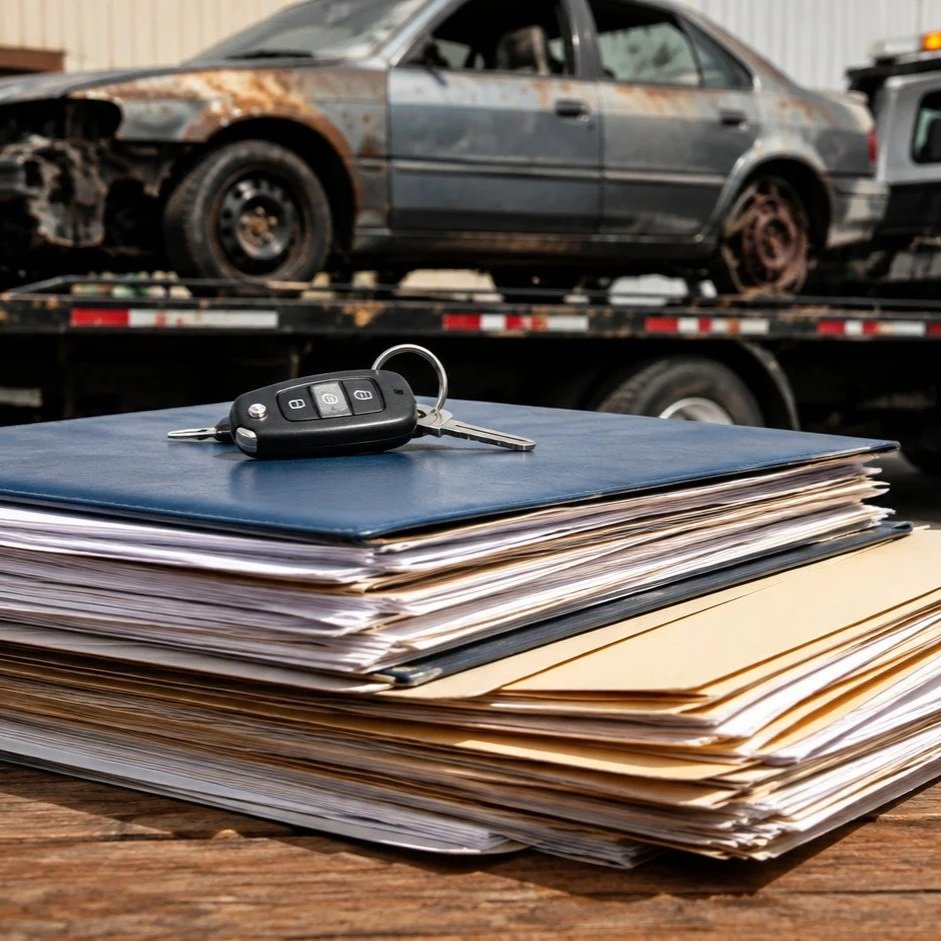
The title is the single most important document in the sale. It is the state's record of who owns the vehicle, and signing it over is what legally moves the car from you to the buyer. No title, and most reputable buyers will slow down or ask for extra paperwork before they pay.
Sign it the way the title tells you to: A title has a seller section, usually on the back, with lines for your signature, the date, and often the odometer reading.
TIP: Fill out the title's seller section exactly as printed, on the marked lines for your signature, the date, and the odometer reading. Do not scribble outside the lines or use correction fluid, because a title with cross-outs or whiteout can be rejected.
If the title is lost, apply for a duplicate: A misplaced title is not a dead end. Your state's DMV or MVD issues duplicate titles, usually through a simple application, a fee, and proof of identity. Order the duplicate before you schedule pickup so the replacement is in hand when the buyer arrives. If a lender is holding the title because of an old loan, that is a lien situation, covered further down.
A Photo ID That Matches The Name On The Title
The buyer needs to confirm that the person signing the title is the person who owns the car. A current, government-issued photo ID does that. A driver's license is the usual choice, but a state ID card or passport works in most cases.
The name on your ID should match the name on the title. If they do not line up because you changed your name after a marriage or divorce, bring the document that bridges the gap, such as a marriage certificate. A mismatch the buyer cannot explain is one of the fastest ways to pause a sale, so sort it out before pickup rather than in the driveway.
Registration And The VIN
Current or recent registration is a helpful second layer of proof. It ties your name to the vehicle and confirms the car is the one on the title. Even an expired registration is worth keeping in the folder, since a junk car is often one that stopped being driven a while ago.
The registration is also where you confirm the vehicle identification number, or VIN. This 17-character code appears on the title, the registration, and the car itself, stamped on a plate at the base of the windshield on the driver's side and on a sticker inside the driver's door jamb. Check that all three match before the buyer arrives. A VIN that disagrees between the paperwork and the car is a red flag that has to be cleared up first.
A Bill Of Sale, And What To Put In It
A bill of sale is the receipt for the transaction. Some states require one for a junk car sale, and some do not, but having it protects both sides either way. It records that the car changed hands, on a specific day, for a specific amount, in as-is condition.
What a useful bill of sale includes: Keep it simple and complete. A workable bill of sale names both the seller and the buyer, gives the vehicle's year, make, model, and VIN, states the sale amount, and notes the date. Because a junk car is sold as-is, add a line saying the vehicle is sold with no warranty. Both parties sign, and each keeps a copy. That copy is your evidence of when you stopped being responsible for the car, which matters if a question comes up later.
A Lien Release If The Car Ever Had A Loan
If you financed the car, the lender likely held a lien, meaning it had a legal claim on the vehicle until the loan was paid. A junk car buyer cannot take clear ownership while a lien is still on record, even if you finished paying years ago.
When a loan is paid off, the lender releases the lien, and that release needs to show up in the paperwork. Depending on your state, that appears as a stamped section on the title, a separate lien release letter, or an updated title with the lien removed. If you paid the car off long ago and never dealt with this, contact the lender and ask for a lien release document before the sale. Handling it in advance keeps the buyer from having to wait on a bank.
The Release Of Liability That Protects You After The Car Is Gone
Here is the step people forget, and the one that can cost you months after the car is towed away. A release of liability, also called a notice of transfer or notice of sale, tells the state you no longer own the vehicle as of a certain date. Without it, the car can still be tied to your name in state records.
Why that matters is concrete. If the new owner racks up a toll, a parking ticket, or gets the car flagged before the state updates its records, those can land on you when your name is still attached. Filing the release of liability, often available online through your DMV or MVD, timestamps your exit. Many states let you file it the same day you sell. Keep the confirmation with your bill of sale so you have a dated record that the car was no longer yours.
Before The Buyer Arrives: Plates, Insurance, And Your Belongings
Paperwork is most of the job, but three quick tasks finish it and keep you protected.
Remove the license plates: In many states, the plates stay with you, not the car, and you either keep them, transfer them to another vehicle, or return them to the DMV. Take them off before the car is loaded. Leaving plates on a junked vehicle can keep it linked to you, and a plate that ends up on another car is a headache you do not want.
Cancel or transfer your insurance, but not too early: Call your insurer only after the car is sold and gone, not before. If you cancel while the car is still legally in your name and something happens to it, you could be exposed. Once the sale closes and the release of liability is filed, cancel the policy or move the coverage to a replacement vehicle so you stop paying for a car you no longer own.
Clear out your personal information: A car that has not run in a while often becomes a storage unit. Check the glovebox, center console, trunk, visors, and under the seats. Old registration and insurance cards carry your address and other personal details, and garage-door openers, spare keys, and paperwork with account numbers can all get left behind. Pulling them out protects your privacy and keeps sensitive information from riding off with the vehicle.
Can I sell a junk car that is still registered to a deceased relative?
Usually yes, but it takes an extra step. The estate has to pass ownership to you first, which often means presenting the death certificate and either probate paperwork or a small-estate affidavit, depending on your state and the estate's value. Once the title is transferred into your name or the estate representative's name, the sale proceeds like any other. Your DMV or MVD can tell you which form your situation calls for.
What if the car was never titled in my name, like one I inherited or was given?
You generally cannot sell a car you are not the titled owner of. The transfer has to be completed first, so the state's record shows you as the owner. For a gift, that means the previous owner signs the title over to you, and you retitle it; for an inherited car, the estate process applies. Buyers verify the titled name against your ID, so this cannot be skipped.
Do I need a smog or emissions certificate to sell a junk car?
For a car being sold to a licensed junk or salvage buyer for dismantling, an emissions test is often not required, since the vehicle is not going back on the road. This differs from a normal used-car sale, where some states do require a current smog certificate. Because the exemption depends on the buyer's license type and your state's rules, confirm it with your DMV or MVD rather than assuming.
Should I get anything in writing about how the car will be paid off if I still owe on it?
Yes. If the offer for the car is less than the remaining loan balance, get the payoff arrangement in writing before you hand over the keys. Ask the lender for the exact payoff amount, which includes any accrued interest and can differ from the balance on your last statement. Knowing that number keeps a surprise gap from stalling the sale at the last minute.
Does a salvage title change what paperwork I need?
A salvage title, issued when an insurer declared the car a total loss, is signed over much like a standard title, and the same ID, bill of sale, and release of liability still apply. The main difference is that the salvage brand carries forward to the buyer, so make sure the title in hand is the salvage version and not a lost standard title you assumed was replaced. Buyers who dismantle cars work with salvage titles routinely.
How long should I keep copies of the paperwork after the sale?
Keep your signed bill of sale, a copy of the transferred title if you can get one, and the release of liability confirmation for at least a couple of years. If a toll, ticket, or registration question tied to the old car ever surfaces, that dated file is what proves the car was no longer yours as of the sale date. Storing a photo of each document on your phone is a simple backup.
Gather your title and ID, then call for a cash offer — one call turns a parked junk car into money in hand. I Buy Junk Cars serves Phoenix and across the Valley. Call (480) 771-8290.