Can You Sell a Partially Stripped Car? What Changes
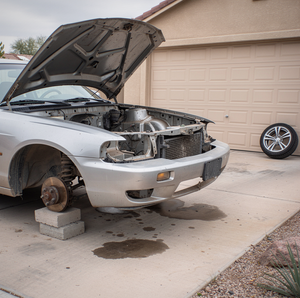
Your car is up on blocks with the hood off and the engine bay empty. Two answers decide everything that follows: which parts came off, and whether the shell still rolls. One sets what it is worth. The other sets what has to arrive to take it away.
Yes, you can sell it. A car missing an engine, a set of wheels, an interior, or all three is still a car somebody buys. The fear is that a picked-over car has nothing left worth hauling; it does. The hope is that the shell still carries what the whole car did; it does not. Where yours lands depends on which pieces are gone.
An Offer Rests on Parts Demand or on Material Weight
A car gets bought on one of two bases, and knowing which one yours was headed for tells you which removals mattered.
The first is recoverable parts. A component gets pulled, tested, and resold because somebody repairing the same model will pay to skip a new one. That path needs the model still on the road in numbers and the part testable before it goes back in, which is why an alternator moves and a cracked bumper cover does not.
The second is material. With no resale path left, the vehicle is taken for what it is made of, weighed and sorted by which metals separate from the mix.
An ordinary used car sits in both at once. Stripping walks a car toward the second, because the pieces that come off with the least effort are the pieces the resale path was built on. Once the drivetrain and the interior are gone, what you are left holding is structure.
So it sells. The sharper question is which removals took something with them.
Why the Small, Dense Parts Are the Ones That Count
Your car body is mostly steel, and steel comes out of a shredded stream magnetically in bulk, with no one handling it. That makes sheet metal forgiving: it goes by the ton, and a dent or a missing door barely moves the number.
The parts that count, out of proportion to their size, are not steel, and they sort by how much work it takes to remove the metal. At one end is a lead-acid battery: a block of lead in its own case, lifted out whole, no separation at all, and a cast aluminum wheel is the same kind of item. Further along, a radiator or condenser is copper and aluminum bonded into a thin core, so it comes off intact and is handled as its own material instead of going into the mix. Further still, the copper in a wiring harness is inside insulation and threaded through the whole car, which is why a harness is stripped by hand or left.
Two removals reach both bases at once. An engine and a transmission are heavy castings with their own resale value, so pulling them requires pulling from both sides in one motion.
Your shell does not make that back. What came off was material that would have been recovered on its own.
Some Removals Change How the Car Has to Be Loaded
The other effect of stripping shows up at the curb on pickup day: the parts that come off with hand tools and sell on their own are the parts a tow operator relies on.
Wheels first. Yours will not roll without them, and a car that will not roll cannot be hooked with a wheel lift, so the shell goes flat on a deck. A driver brings skates and dollies when your call warned him.
Steering next, and it only matters once the pull has started. With the ignition lock or the column gone, nobody aims the front wheels while the winch takes up cable, and a winch pulls straight. Your shell gets lined up dead straight first, or picked up bodily.
The drivetrain cuts both ways. Transmission out with the hubs still on, and the wheels turn freely, so the shell moves more easily than when it ran. Transmission in with the linkage gone, and nothing selects neutral: the driven wheels lock, and it gets dragged.
Glass changes what the shell can take. On a unibody car, the windshield is bonded in and carries structure, so a shell with it out flexes, and the strap points stop being obvious.
That is a scheduling fact rather than a valuation one. It decides which truck comes and how long your stop takes.
Which Systems the Stripping Left Open
Everything liquid on a car sits in a closed circuit, and every circuit ends at a part somebody can unbolt. Take the radiator off, and the coolant remains in the lower hose. Cut a fuel line, and the tank vented. Unbolt the compressor and the refrigerant went when the fitting came loose. None of it is work waiting for you; it already happened, and only you know it did.
Coolant is the one worth your attention, for where it landed. Ethylene glycol tastes sweet, and it is poisonous, so a green puddle on your concrete stays a problem for a dog or a small child after the shell is gone. Hose it off for your own sake; no buyer needs it done.
Fuel needs nothing cleaned up and one sentence on the phone. An open tank or a cut line leaves vapor behind, and vapor is why no grinder or torch belongs near the shell while it waits. Say the fuel system is open when you book.
Whatever is still sealed stays sealed. Do not drain the tank, the oil, or the transmission before the truck comes: that hands you waste oil you now own and a spill to explain, and changes nothing about the offer. Sealed stays shut; opened gets described on the phone.
Ownership Is the One Thing Condition Does Not Touch
Nothing about handing your car over changes because parts are missing. A buyer has to establish that whoever releases the vehicle is entitled to do so, and that check applies equally to a car that starts and to a car on blocks with its doors in the garage.
The one place stripping touches this is the VIN. The plate at the base of the windshield leaves with the dashboard, and the door-jamb label leaves with the door. The number is also stamped into the body structure and printed on your paperwork, so the match still gets made. Knowing where yours is readable saves a conversation at the curb.
Which documents you need and what happens if your title is gone have answers of their own, and nothing in it shifts because your car is incomplete. What is required differs by where the sale happens, and the buyer will tell you what to bring.
A shell with a clear line of ownership gets picked up on the same schedule as a running car. A complete car with an ownership question waits.
Frequently Asked Questions
Yes, and the empty bay changes the loading more than the sale. With the drivetrain gone, your nose rides light, and the mounts a driver would normally strap through are gone, so the tie-downs go through the lower suspension arms or a frame rail. Say the engine is out when you call.
You do not have to inventory it bolt by bolt, and photographs settle it faster than talking. Shoot the open engine bay first, because nothing else in a photo says whether the drivetrain is there. Then one corner, which answers whether your shell rolls. Then the underside, the only view where the exhaust and subframe show.
They can, as long as they are in or on the shell before the truck arrives. What leaves is what is loaded; parts sitting in your garage are separate items. If you want the seats or the hood to go with the car, put them inside and say so when you schedule.
The line is a structural one. A shell missing every bolt-on part is still a vehicle a wrecker can lift and haul. A body cut apart with a torch, or a frame separated into sections, is no longer a vehicle for movement: it is loose material, handled by a loader. Say up front if yours has been cut.
Yes, and the driver handles it. A hood with no latch, or a fender resting on a tire, is strapped or removed before the shell moves on a public road. That is two minutes at the curb when the driver saw it coming in your description, and a second trip when he did not.
The shell is stored, picked over for anything still resale-grade, then processed. One step is easy to miss on a stripped car: an undeployed airbag inflator is a pyrotechnic device, so any inflator still in the shell is either deliberately deployed or removed by hand first. Whoever pulled your steering wheel and skipped the module left that job where it was.
That shell in the driveway is still a pickup somebody can schedule — free towing, any condition, no repairs and no cleanup before the truck arrives. I Buy Junk Cars serves Phoenix and across the Valley. Call (480) 771-8290.