
Selling a Flood-Damaged Car: What the Water Left Behind
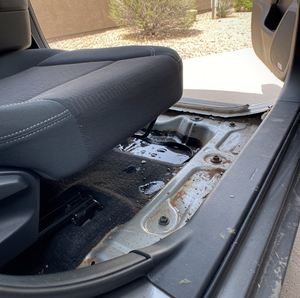
Water that crosses a car's door sills reaches the floor pan, the seat frames, the wiring harnesses that run along the floor, and the control modules mounted low in the cabin, all before it ever shows on the dash or the upholstery above the seat line. It keeps changing the vehicle long after the last visible puddle is gone, working into places a hose and a shop vacuum never touch.
Quick Answer: Floodwater damages a car in layers beneath the surface: the interior padding, the electrical system, the sealed drivetrain, and the safety modules all retain moisture differently, and the damage continues to develop long after the car is dry and running again.
The distinction that matters is between what got wet and what got soaked. A car that took some spray on the outside is a car you wipe down. A car where water crossed those sills and reached the floor pan is a different problem, because water below that line doesn't evaporate the way water on top of the dash does. It sits against metal, fabric, and electrical connections that were never built to be underwater, and it causes corrosion, delamination, and biological growth that don't stop just because the carpet feels dry to the touch.
A car that starts and drives again after a flood is often more concerning, not less. A running engine and working electronics tell you the immediate damage wasn't total. They don't tell you what's happening inside a connector or a control module with moisture trapped against its circuit board. In most cases, a vehicle submerged past the floor is on a one-way path, and the real question isn't whether more problems show up. It's how many, and how soon.
Do not try to start an engine that was submerged; water trapped in a cylinder can bend a connecting rod or crack the block when the engine turns over. A flooded electrical system is also a fire risk.
What Water Does to a Flooded Interior
Water that reaches the cabin floor doesn't just wet the carpet — it soaks into everything underneath it.
Carpet padding and jute backing: The padding sits directly against the floor pan and holds water against bare metal long after the surface carpet looks and feels dry, which is exactly the condition that starts corrosion underneath.
Seat foam and frames: Foam absorbs and holds water the same way padding does, and the metal seat frames and the sliding tracks beneath them are now in a permanently damp environment.
Sound-deadening material: The mats and pads bonded to the floor pan and firewall to control road noise absorb water and can delaminate. Once they separate from the metal, they trap moisture against it instead of protecting it.
The ventilation system is tied into this as well. Water that reaches the floor often reaches the ducting and blower housing that route air through the cabin, where mold and other biological growth can establish. Every time the HVAC system runs after that, it's moving air through a contaminated path.
Where the Electrical System Never Really Recovers
This system keeps producing problems the longest after a flood, because water doesn't damage wiring the way it damages fabric. A modern vehicle relies on dozens of connectors, ground points, and control modules, all tied together by wiring that runs at floor level in multiple places, right where floodwater sits.
Connectors and ground points: A connector that's been wet can look fine once it's pulled apart and dried out, but water leaves behind galvanic and electrolytic corrosion inside the pins themselves, and that corrosion keeps spreading slowly even after the visible moisture is gone.
Control modules and circuit boards: Modules mounted low in the cabin or engine bay can take on water directly, and a circuit board that's been wet often keeps working for a while before a trace finally corrodes through.
This is why electrical faults from a flood tend to show up as an intermittent problem nobody can chase down: a warning light that comes and goes, a module that resets itself, a sensor that reads correctly most of the time. The corrosion takes time to fully develop, and by the time it causes a diagnosable fault, the flood that caused it is easy to forget about.
The Drivetrain and Anything Sealed with Lubricant
Water finds its way into components meant to be sealed against it, because a submerged vent, breather, or dipstick tube gives it a path in.
Engine oil and transmission fluid: Fluid that's taken on water typically looks milky instead of running clean, and once water has emulsified into a lubricant, it stops doing the job of protecting the moving parts inside.
Differential and transfer case: These run their own sealed lubricant and are just as exposed as the engine and transmission if the vehicle sat deep enough, and they're easy to overlook because nobody checks them the way they check a dipstick.
The fuel tank: a full or partly full tank can take on water through the filler neck or a vent line, and once water is in the fuel system it affects everything downstream of the tank.
The alternator and starter: Both are mounted low in the engine bay, both are electrical components, and both are common early failures on a flooded vehicle, whether or not the drivetrain shows a problem yet.
Safety Systems That Sat in Water
The airbag control module and occupant sensors: This module is typically mounted low in the cabin, near the transmission tunnel or under a seat, which puts it in the water on almost any flood that reaches the floor. It's also the module responsible for deciding whether and how the airbags deploy, working together with the seat sensors that help make that call. Corrosion inside that module or its wiring doesn't necessarily show up as an obvious fault. It can just as easily mean the system doesn't behave correctly if it's ever needed.
Do not disconnect the battery on a car with undeployed airbags that sat in water, and avoid working underneath a vehicle that stood in floodwater. Mold and contaminated water inside a closed cabin are a real health exposure.
Fresh Water, Salt Water, and a Soaked Footwell Are Different Problems
Not every flood is the same, and differences affect how far the damage is likely to extend. Rising fresh water (a creek overflow, a burst garage pipe, a flooded parking structure) causes real damage, but it's the least aggressive of the three. Salt water is far more corrosive to metal and to the same connectors and ground points described above, so a vehicle exposed to salt water tends to develop electrical and corrosion problems faster than one exposed to the same depth of fresh water.
A soaked footwell from a leak, such as a failed windshield seal, a clogged sunroof drain, or a failing heater core, is narrower in scope but not necessarily minor, since it can go undetected for a long time and saturate the padding and floor pan under one area before anyone notices the carpet is wet. The waterline left on interior panels, upholstery, and even under the hood is one of the clearest pieces of evidence for how deep a vehicle sat and for how long, and it's often more informative than asking the previous owner what happened. A musty smell that lingers after cleaning, particularly when masked by heavy air freshener, is another sign of moisture still trapped somewhere in the vehicle.
What a Buyer Actually Looks at on a Flood Vehicle
The basic factors behind any offer, a vehicle's weight and metal content, its recyclable parts, and current scrap market conditions, don't change because a car flooded. What changes is what those factors run into once water has been through the vehicle:
| What Water Reached | What That Means for an Offer |
|---|---|
| Just the floor pan and lower door panels | Interior padding and sound-deadening are affected; the drivetrain and electronics are more likely untouched |
| Up past the seats and toward the dash | Electrical connectors, control modules, and possibly the airbag system were submerged |
| The engine bay and drivetrain | Oil, transmission fluid, the differential, and other sealed components may have taken on water |
| Enough to stall the engine while it was running | The vehicle may not move under its own power, which changes how it's loaded for pickup |
| The waterline itself, visible on panels or upholstery | Shows a buyer roughly how the vehicle sat, without relying on a secondhand account |
A real number for a specific vehicle comes from an actual quote, not a general one, because the extent to which water reached into the drivetrain and interior varies widely from car to car, even within the same flood event.
The Paperwork Side, in Brief
How a vehicle's paperwork is handled after a flood depends entirely on where it's registered and on whether an insurer was involved, and the requirements and terms used differ from place to place. The DMV or equivalent titling agency is the authority on what applies to a specific vehicle. Questions about an active claim belong with the insurer handling it.
Why Drying It Out and Driving It Is Usually the Expensive Choice
Everything above adds up to the same practical answer. Drying out the carpet, running a fan through the cabin, and getting the engine to turn over addresses what's visible and not much else. The wiring, the control modules, the sealed lubricants, and the airbag system are all still carrying whatever water reached them, and none of that reverses with time or a dehumidifier. A vehicle in this condition tends to keep costing money in small, unpredictable amounts for as long as it stays on the road, and each new problem gets harder to trace back to the flood the longer the car has been driven since. Selling it while it's still complete and before more of those systems fail is usually the choice that costs less overall.
Frequently Asked Questions
The spare tire well and the floor pan under the trunk carpet are easy to overlook, since almost nobody checks under the trunk liner the way they check the cabin floor. Water that pools there can sit for a long time, starting rust in the trunk floor pan well after the rest of the car has been cleaned up.
Yes. Seat belt webbing is made of woven fibers that absorb water, and repeated wet-and-dry cycles can reduce its strength even though the belt still buckles and retracts normally. The pretensioner cartridge built into most seat belt systems is also a pyrotechnic device, evaluated separately from the airbag control module.
Window regulator motors, power door lock actuators, and speaker cones sit low in the door cavity, which usually floods before water reaches the dashboard. These tend to be among the first components to fail, well after the rest of the vehicle seems to be running fine.
Often, yes. Diagnostic trouble codes and freeze-frame data related to water intrusion can remain stored in a vehicle's control modules, and a technician can retrieve that history with a scan tool even after the interior has been cleaned and the modules appear to be working.
The body control module, often mounted behind a kick panel, and the wiring junction blocks tucked under the dash are common points where corrosion develops out of sight. Because they're buried behind trim, problems in that spot often don't surface until a technician is already chasing a different complaint.
The parking brake cable and its housing, along with brake line fittings near the floor, can trap water where corrosion isn't apparent in the pedal feel. A technician typically inspects these specifically after exposure to flooding, separate from a general check of the hydraulic brake system.
List a flood-damaged vehicle for an inspection and a same-day cash offer — no drying it out or guessing what still works first. I Buy Junk Cars serves Phoenix and across the Valley. Call (480) 771-8290.