How to Prepare Your Car for Junk Pickup: 9-Step Checklist
QUICK ANSWER: Before a junk car is towed, empty every compartment, pull the plates, gather the title, cancel or transfer the insurance and registration after the sale, remove any aftermarket parts you want to keep, note the odometer, leave the fuel and fluids for the buyer, and make sure the tow truck can reach the car with keys on hand.
Selling a car for scrap feels like the finish line, and in most ways it is. The buyer quotes you, sends a truck, and hands over cash. Still, the twenty minutes before that truck arrives decide whether the handoff is clean or whether you spend the next week untangling a canceled policy, a lost garage remote, or a title question you could have settled up front. A little prep protects you the same way clearing off a kitchen counter before movers arrive protects your good dishes: once the truck rolls away, whatever you left behind is gone, and chasing it down later is far harder than a quick sweep now.
The steps below are a plain checklist. None of them take long, and each one closes a small gap that otherwise turns into a phone call later.
Why a Few Minutes of Prep Pays Off
A junk car pickup is fast by design. The driver confirms the vehicle, loads it, pays or hands off the check, and leaves. Once it is on the truck, you have no practical way to retrieve a forgotten item or correct a detail. Prep is your only window.
Two things are at stake. The first is your stuff and your paperwork: belongings, plates, and the title trail that ties your name to the car. The second is your standing after the sale, meaning the insurance and registration that keep costing or exposing you until you close them out. Handle both before the truck arrives, and the sale ends the moment the car leaves your driveway, which is exactly what you want.
Empty the Car Completely
People stash more in a car than they remember. Go through it slowly, as if you were cleaning it to sell to a neighbor rather than scrapping it.
Check every spot that holds small items:
Glovebox and center console, including any hidden tray underneath
Trunk, spare-tire well, and the cargo area under the load floor
Under and between all seats, plus the seatback pockets
Both visors, where garage remotes and toll transponders hide
Cupholders, door pockets, and any dash cubby
Watch for the easy-to-forget items: Garage door openers, parking permits, toll tags, phone chargers, sunglasses, insurance cards, and registration slips all tend to live in a car for years. A garage remote left in a scrapped car is a small security worry, so pull it and deactivate it if you can. If you kept a spare house key in the car, take it too.
TIP: Do one final pass with a flashlight. The gap under the seats and the seams of the trunk liner are where a wallet or a set of keys quietly disappears, and once the truck rolls away, whatever you left behind is gone.
Remove the License Plates
In most places, the plates come off before the car is towed, and the buyer will expect the car to arrive without them. Grab a screwdriver, take the front and rear plates, and set them somewhere safe.
What you do with the plates next depends on where you live. Some areas want you to return the plates to the motor vehicle agency, some let you transfer them to another vehicle you own, and some simply have you destroy or recycle them. Rules on this vary by state, so check your local motor vehicle agency's guidance rather than assuming. Keeping the plates in hand also stops them from being reused on another car while they still trace back to your name.
Cancel or Transfer Insurance and Registration After the Sale
Timing matters here. Keep the car insured and registered until the sale is actually complete, because you want coverage while it still sits in your driveway and while it is being handled. Once the car is sold and gone, contact your insurer to cancel or move the policy to another vehicle, and follow your local agency's steps for ending or updating the registration.
Two reasons not to skip this. Paying for coverage on a car you no longer own is money leaking out for nothing. More important, leaving the registration in your name on a vehicle you have released can leave you tied to it on paper. Closing both out promptly cuts that thread cleanly.
Gather the Title and Paperwork
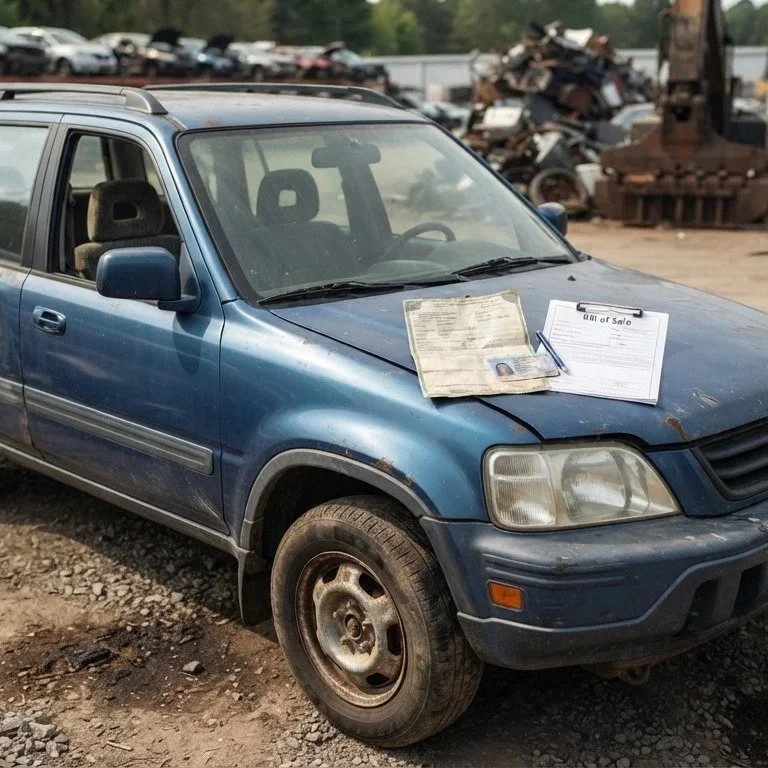
The title is the document that proves the car is yours to sell, and having it ready makes the pickup faster. Find it before pickup day so you are not digging through a filing cabinet while the driver waits.
If you have the title, sign it over according to the instructions printed on it and the buyer's guidance. Bring your photo ID as well, since many buyers confirm the seller's identity against the paperwork.
If you cannot find the title, do not assume the sale is off. Many junk buyers purchase vehicles without a title or with alternate documentation, depending on local rules. Requirements for title-free sales vary by state, so ask the buyer what they accept and check your local motor vehicle agency for how a replacement or substitute document works in your area. Sort this out on the phone before pickup day rather than at the curb.
Remove Aftermarket Parts You Want to Keep
A junk offer is usually based on the car as a whole, so anything you unbolt and keep is yours, but it may shift the quote. Decide before the truck comes.
Parts owners commonly pull to keep or resell:
Aftermarket stereo, speakers, or amplifier, if you paid to upgrade the audio·
Custom or newer wheels and tires, especially a set worth more than the scrap value of the car
Portable GPS, dash cam, or phone mount, which are quick to unclip
A recently replaced battery or nearly new set of tires, which have resale life left
Tell the buyer what you plan to remove when you get your quote, because stripping valuable components can lower the offer, and a buyer who quoted on a complete car should know what is leaving with you. It is fine to keep parts, as long as everyone agrees on the car's condition before the truck arrives.
One caution: leave safety and emissions components in place. Removing airbags, catalytic converters, or similar parts yourself can be unsafe and is restricted in many areas, so this is not advised. Stick to the bolt-on extras you added.
Note the Odometer and Condition
Before the car leaves, jot down the odometer reading and take a few photos of the exterior, interior, and dash. Some paperwork asks for a mileage figure at the time of sale, and having it recorded saves a scramble.
Photos are your record of the car's condition at handoff. They confirm what you released and in what shape, which is useful if any question comes up later about the vehicle after it is gone. A dozen quick phone pictures cost you nothing and settle disputes before they start.
Leave the Fuel and Fluids Alone
It is tempting to think you should drain the tank or the oil first. Do not. Junk buyers and tow operators are set up to handle fuel, oil, coolant, and other fluids safely and dispose of them properly; draining them yourself creates a spill hazard and a mess with no upside.
Leave the gas tank as it is, whether it is nearly empty or has a quarter tank left. The buyer factors fluids into how they process the car. Your job is to hand it over; theirs is to drain and recycle. This is one of the few steps where doing less is the correct move.
Make the Car Accessible and Confirm the Pickup
A tow truck needs a clear path and a straight pull. Save the driver a headache and yourself a delay.
Clear the approach: Move any other vehicles blocking the junk car in the driveway or at the curb. If the car is behind a gate or in a tight spot, mention it when you schedule so the right truck comes.
Have the keys ready: If you have the keys, set them aside to hand over, since keys make loading and steering easier. If the keys are long gone, say so up front; most buyers tow keyless cars routinely, but the driver likes to know in advance.
Confirm the details: A quick call or text the day before locks in the pickup window, the address, the agreed offer, and how you will be paid. Confirming also flags anything the driver should know, like a low-clearance carport or a car parked on a slope. A two-minute confirmation prevents the most common pickup-day surprises.
Do I have to be present when the tow truck arrives?
Usually someone should be there to hand over the keys, the signed title, and to receive payment, but arrangements vary by buyer. If you cannot be home, ask whether they allow a stand-in with the paperwork and keys, or an alternate payment method. Settle this when you schedule so the driver is not stuck at an empty house.
What happens to my car after it is towed away?
Most junk vehicles are drained of fluids, then either dismantled for reusable parts or crushed and shredded so the steel and metals can be recycled. Usable components such as alternators, doors, and catalytic converters are often pulled and resold before the shell is scrapped. Very little of a car actually reaches a landfill.
Can I sell a car that will not start or is missing parts?
Yes. Non-running cars, cars that were partially stripped, and cars with dead batteries are standard junk purchases, since the value is largely in the metal and salvageable parts. Tell the buyer up front what does not work and what is missing so the quote reflects the real condition and there is no back-and-forth at pickup.
Should I clean or wash the car before pickup?
A full wash is not necessary, since the car is being scrapped, not sold to a driver. Clearing out your belongings matters far more than appearance. A quick rinse only helps if grime is hiding damage you want captured in your photos; otherwise, skip it and spend the time on the interior sweep.
Does removing the catalytic converter get me a better deal?
No, and it is not worth attempting. Buyers already account for the converter in their offer, and a car arriving without one typically brings a lower quote, not a higher one. Pulling one yourself can also run afoul of local rules, so leave it in place and let the buyer handle it.
What if I find something valuable in the car after it is gone?
Once the car is towed, retrieving an item is difficult and not guaranteed, since the vehicle may already be in line for dismantling. Call the buyer immediately if you realize you left something, as a quick call soon after pickup gives the best chance of recovery. The reliable fix, though, is the slow flashlight sweep before the truck arrives.
Ready to hand off the car with no loose ends — get a fast quote and free towing on any vehicle, running or not. I Buy Junk Cars serves Phoenix and across the Valley. Call (480) 771-8290.