Selling a Burned Car: What to Expect From Fire to Flatbed
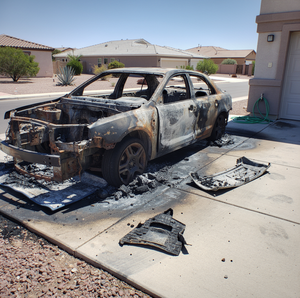
The shell is still sitting where it stopped. The front tires burned off the rims, the windshield is gone, and a grey ring of ash and dried foam marks the concrete around it. Three days have passed, and nobody has touched it, because nobody is sure what touching it would mean.
That hesitation is reasonable. A burned vehicle is not a junk car with worse cosmetics. It holds stored energy the fire did not consume; it may no longer belong to you, and its value turns on questions that never arise with a car that simply stopped running.
What a Burned Vehicle Is Still Doing After the Fire Is Out
Three impulses show up in the first day, and all three make things worse.
The first is to try starting it. A fire in the engine bay chars the insulation off the low-voltage wiring, and charred insulation is not an insulator, because carbonized polymer conducts. The battery may still be holding charge, so turning the key pushes current into conductors that now touch each other and touch the shell. That is how a car left cold at midnight burns again at two.
The second is to push or roll it out of sight. Brake hoses are rubber, and rubber cooked at fire temperatures will not hold pressure. Bearings, seals, and whatever is left of the tires went through the same heat, so a vehicle rolling down a driveway has nothing to stop it.
The third is to open the doors and go through it to see what survived. That is a health question rather than a mechanical one, and it needs to come first in the next section.
There is also the ground under the car. Firefighting water carries fuel, oil, coolant, brake fluid, and melted plastic, and fluids keep seeping from split lines for days. Storm drains are not sewers; most discharge to a channel or waterway untreated. Keep the car on pavement, away from the nearest drain inlet, with absorbent under the low points.
The Hazards That Outlast the Flames
Airbag modules come first. An inflator holds a solid propellant that is stable in normal service but much less predictable after heat-soaking without firing. Surviving the fire is not proof that a module is safe; it went through a chemical cycle nobody can inspect from outside. Seatbelt pretensioners work the same way.
Second is a high-voltage battery pack, if the vehicle carries one. Damaged cells can enter thermal runaway with a delay measured in hours or days rather than minutes, because heat can move from cell to cell within a pack that appears inert. Treat it as live while it sits there, and park it away from the house.
Then the ordinary pressure vessels. Fuel tanks on most cars are molded plastic, and one that survived a cabin fire can still hold liquid fuel and vapor. Hood and hatch struts are sealed gas cylinders, and any unburned tire is still inflated.
Last is the residue. Interior foam, dash plastics, wiring insulation, and seat fabric burn into a soot carrying acids, hydrocarbons, and heavy metals. Settled ash is not inert: it goes airborne the moment somebody lifts a seat, and it transfers to skin, to clothing, and into the house.
Heat-exposed airbag modules can fire without warning, and a damaged high-voltage pack can reignite hours or days after the fire is out. Nobody should be inside a burned vehicle without eye protection, gloves, and a fitted respirator.
If the vehicle is a hybrid or an electric, say so on the first phone call. It changes the truck, the storage, and who may touch the car.
Settle the Insurance Question Before You Talk to a Buyer
This is the first call, ahead of any buyer, and it is where people lose money.
An auto policy that covers fire loss pays out at the vehicle's actual cash value, and in exchange the insurer takes what is left of the car. The salvage becomes the insurer's property, and the title goes with it, so the wreck somebody is offering cash for may already be spoken for. Selling it with the claim open can cut the payment or sink it.
There is a second path. Many insurers will allow the owner to keep the vehicle and deduct its salvage value from the settlement, a practice known as owner-retained salvage. That is the route that leaves you something to sell, and it has to be agreed before the claim closes.
An insurer may also want the car left undisturbed while the cause is examined. If no claim exists, none of that applies: plenty of burned cars carry liability-only coverage, and nobody else has an interest in them.
What Actually Determines What a Fire-Damaged Car Is Worth
Nobody buys a burned car to repair and drive it, which deletes every question that prices a used car. What is left is a parts-and-materials question with two halves: the parts still sellable, and the weight of the metal underneath.
The general arithmetic of a junk car offer is the same for any vehicle; what fire changes is which half of it survived. So the first question a buyer asks is where the fire started and how far it spread. Three patterns cover most vehicle fires.
| Where the fire started | Usually still sellable | Usually gone |
|---|---|---|
| Engine bay | Seats and interior, rear glass, rear suspension, quarter panels | Engine accessories, front wiring, hood, front fenders |
| Cabin | Engine, transmission, differential, suspension, wheels | Interior, all glass, the wiring, roof and pillar strength |
| Rear or fuel tank | Front drivetrain, front suspension, windshield, doors | Tank, rear suspension, quarter panels, rear exhaust |
The catalytic converter gets checked early because platinum, palladium, and rhodium are elements and do not burn away. A converter that has been through a fire usually still holds its metals even when the ceramic substrate has cracked from thermal shock. What it contributes depends on the model's loading.
Aluminum wheels get their strength from a heat treatment, and sustained temperatures in the range a car fire reaches anneal that temper out. A wheel that stood in the flames sells by the pound as aluminum; one at the far end of the car is often still a wheel.
Glass survives only where the heat did not reach. Anything in or near the fire is gone: tempered side and rear glass shatters from thermal shock before the fire is out, and a laminated windshield delaminates and clouds. At the opposite end of the car, it often comes off intact.
The drivetrain is where the value hides on a cabin or rear fire. An engine and transmission that never saw flame are rebuildable cores, though every seal, sensor, and rubber line on them gets replaced. An engine that sat under it is a bare block and a crankshaft.
Underneath all of it is the shell. Steel and iron make up more than half the weight of a typical passenger car, and steel sells by weight, not appearance. Fire does not remove weight, which is why a gutted shell still carries a number.
Water damage is judged on entirely different evidence: silt lines, corrosion at the connectors, and how long the car sat submerged. A collision car is judged on how straight its structure still is. A burned one is judged on how far the heat traveled.
Title, Branding, and the Paperwork That Burned With the Car
A salvage brand is a permanent notation attached to the vehicle identification number in the state's record, not something written on a bill of sale, and it is designed to follow that VIN through every later transfer. Fire vehicles usually end up branded, either because an insurer settles the loss and applies for the brand, or because the damage crosses the state's threshold relative to the car's value. What qualifies comes from that definition, not from how the car looks.
The state title agency is the authority here, not a buyer and not an article. Rules for a duplicate title, an affidavit of ownership, or a physical VIN inspection are written at the state level, and they vary.
Paperwork burning with the car is common, because the title and registration were in the glovebox. Paper is a record of ownership, not the ownership itself: that sits in the state's file against the VIN, and the owner of record can generally apply for a duplicate. Selling with no title at all runs on its own procedure.
A lien changes the shape of the deal. If the car was financed, the lender is recorded as lienholder, and the title cannot transfer clean until the loan is settled and the release issued.
Getting the Vehicle Ready for a Truck It Cannot Drive Onto
The general pickup checklist does not change after a fire, but three items on it behave differently: belongings, plates, and the load itself.
Belongings first, with the residue in mind. Daylight, nitrile gloves, long sleeves, a fitted respirator rather than a paper dust mask, and no climbing into a shell whose floor pan has been through fire. Trunk contents often survive an engine-bay fire, though anything porous holds the soot permanently.
Plates come off before the truck arrives, and after a fire, it's a two-minute job only if the fasteners sat on the cool end of the car. A plate that went through the flames is often unreadable and seized to its bracket. Photograph it and the VIN before anything moves, because the photograph may be the last legible record of either. Whether the plate is then surrendered, transferred, or destroyed is a state question.
Registration and insurance get canceled after the transfer completes, never before. While the wreck is still yours and still on your property, dropping coverage removes the only thing that would respond if it reignites.
Then the load. A burned car cannot be driven onto anything: no engine that will start, usually no brake pressure, often no steering assist, so it is pulled on by cable. Winching needs a pull point still attached to sound structure, and after a bad fire the front subframe may be the only one left.
Before calling for pickup, check that all four tires still hold air and that the car is standing on pavement or dirt. Those two answers decide whether a flatbed and its winch alone can load it.
Pickup Day: What the Tow Operator Needs to See
A rollback deck runs roughly 8 feet wide and about 20 feet long, and it has to tilt back and touch the ground behind the truck before anything is pulled on. The operator needs a straight approach and open ground behind the vehicle, not simply a space the car fits into. Low branches, a narrow gate, or a soft shoulder change the plan.
Which end faces out matters because the cable pulls from one end, while the sound anchor points may exist only on the other.
Structural collapse changes the equipment outright. If the roof has dropped, if the vehicle burned inside a building and carries debris, or if the floor has failed, a rollback and cable may not be enough, and it becomes a wheel-lift with dollies or a boom. Describe what it looks like when booking, and send photos.
The stain on the concrete stays a while. The car does not have to.
Frequently Asked Questions
The sale works the same; the schedule does not. A structure fire brings a second claim on the property, a second adjuster with an interest in the scene, and a car under a collapsed section that cannot be reached until the owner clears the debris.
Keys make almost no difference, since the vehicle will never be started. What matters is whether the transmission can leave Park: on most automatics the shift lock releases electrically, using 12-volt power the car no longer has. If the console burned, the manual override slot near the shifter is gone too, and the car gets dragged on or lifted onto dollies.
Every vehicle carries its number in more than one place: the plate at the base of the windshield, a label in the driver's door jamb, and on most vehicles a number stamped into the body or frame, which generally survives a fire that destroys the other two. If none are legible, the state agency may require a physical inspection.
Yes, at nearly every step. Disconnecting the 12-volt battery does nothing to de-energize the high-voltage pack, which is a common and dangerous assumption. Many haulers and yards also require open-deck transport rather than an enclosed trailer, as well as outdoor storage at a set standoff distance.
Longer than it should, which is why they linger. Heat-crazed plastic tanks and split lines weep fuel and oil for weeks rather than hours, and an open cabin fills with water that mixes with ash into an acidic slurry that etches the concrete under it. Property rules on inoperable vehicles are a separate pressure, and they arrive by letter.
It happens, and it still gets written off, because the damage that matters is invisible from the driver's seat. The underhood fuse and relay box, the ground straps, and the front wiring are heat-damaged even in a contained fire, and annealed copper and scorched connectors fail intermittently for months.
Call with the year, the model, and where the fire started — get a cash offer on a burned vehicle, with free towing and same-day pickup included. I Buy Junk Cars serves Phoenix and across the Valley. Call (480) 771-8290.